

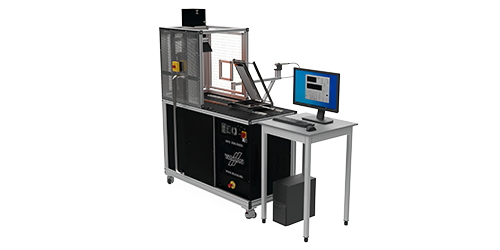
Cone Calorimeter ISO 5660-1
 View Dr.-Ing. Georg Wazau Mess- + Prüfsysteme GmbH on TEKEN44
Reaction-to-fire tests - Heat release, smoke production and mass loss rate The test device is used to access the reaction of building materials to the effect of heat. Heat release, smoke production and mass loss rate are measured. The main function of the Cone Calorimeter is based on the knowledge that the net heat of combustion is in fact proportional to the amount of oxygen required for combustion. The ratio is approximately that 13.1 x 1000 kJ of heat is released per kilogram of oxygen consumed during combustion. The samples are irradiated under laboratory conditions, ignited by sparks and thereby burned. They are exposed to thermal radiation at fixed intervals between 10 kW/sqm - 75 kW/sqm and the changes in oxygen and gas concentration are measured. The principle is called the "oxygen consumption principle" and originates from calorimetry. Furthermore, the flow rate in the exhaust pipe and the loss of mass of the sample are measured. Smoke obscuration is measured as the intensity of the laser light that is transmitted through the smoke in the exhaust pipe. The measurement is used to calculate the extinction coefficient according to Bourger's law. The test results are used to determine smoke production and smoke production rate.
TEKEN44 Similar Products


Google Lens Search · visually similar products
The TEKEN44 product image was analyzed with Google Lens via the TEKEN44 MCP server to find 20 visually similar products from across the web.